On this page
- The manual recommends an internal clean every month with the Self Clean or Intensive cycle and no dishes. 1
- Clean the filters every month: lower rack out, handle counterclockwise, coarse filter and micro filter out. 1
- Take care that the coarse filter is closed properly, since a loose cover can reduce filtering. 1
- The top, upper and lower nozzles each have their own removal steps, and they may break if forced. 1
- The drain pump cover is cleaned when 5C appears or the pump is noisy. 1
In what order should I clean a Dacor dishwasher?#
Start with an empty internal clean, then the filters, then the nozzles, and open the drain pump cover last, only if you need to. The manual recommends the first two every month. It does not rank the jobs, so this order is ours. 1
The reason for this order is practical. Dissolving grease and lime first lets the filters rinse clean, and the nozzles and pump cover are only opened if a symptom points there. Here is the full routine in one place.
| Job | How often | What the manual says |
|---|---|---|
| Internal clean | Every month | Self Clean cycle or Intensive cycle, with no dishes 1 |
| Filters | Every month | Coarse filter and cylindrical micro filter out, rinse, dry, refit 1 |
| Spray nozzles | When clogged, or to prevent it | Remove, unclog, refit and spin by hand 1 |
| Drain pump cover | When 5C shows or the pump is noisy | Lift the cover, clear foreign matter 1 |
| Door seal and tub wall | As needed | Wipe with a damp cloth; do not remove the front seal 1 |
A simple routine is to do the internal clean and the filter on the same day each month, and to wipe the door opening while the tub is open. Leave the nozzles and the pump cover for when a symptom asks for them. Keeping the jobs together makes it easy to notice when a filter is dirtier than usual, which is worth telling us about.
How do I do the monthly internal clean?#
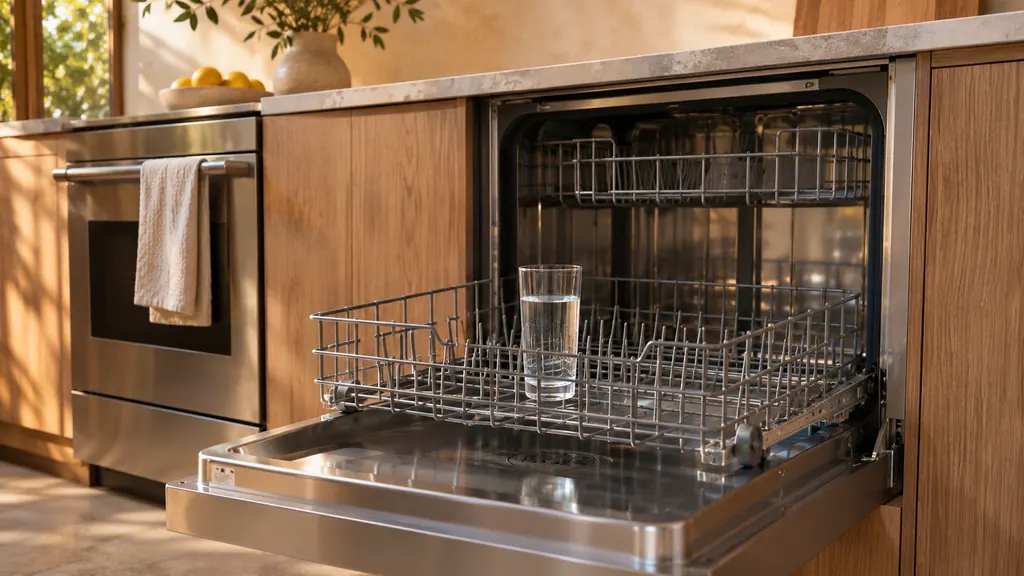
Run the Self Clean cycle or the Intensive cycle with the dishwasher empty. The manual recommends doing this every month. 1 For lime scale or grease deposits, it also says to wipe with a damp cloth, or add detergent and put the empty machine through a cycle at the highest rinse temperature. 1
If your tap water is hard, add citric acid to the detergent when you run the dishwasher. The manual says this can prevent limescale inside the unit. 1
Do not remove the long rubber front seal around the opening. The manual says it keeps the inner side of the dishwasher sealed. 1
How are the filters cleaned?#
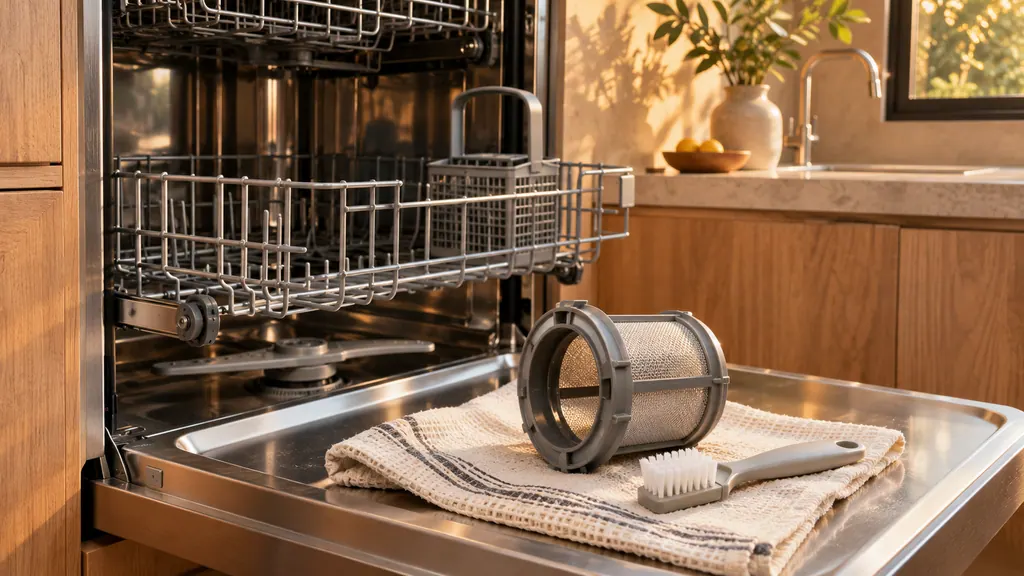
Take the lower rack out, turn the filter handle counterclockwise, pull the coarse filter and then the cylindrical micro filter, rinse both under running water and dry them well. Refit them in the reverse order and lock the handle clockwise. 1
The manual recommends this every month. 1 Hard water makes it more important: the troubleshooting table tells you to clean the filter at least once per month when water is hard. 1
- 1
- 2
- 3
- 4
- 5
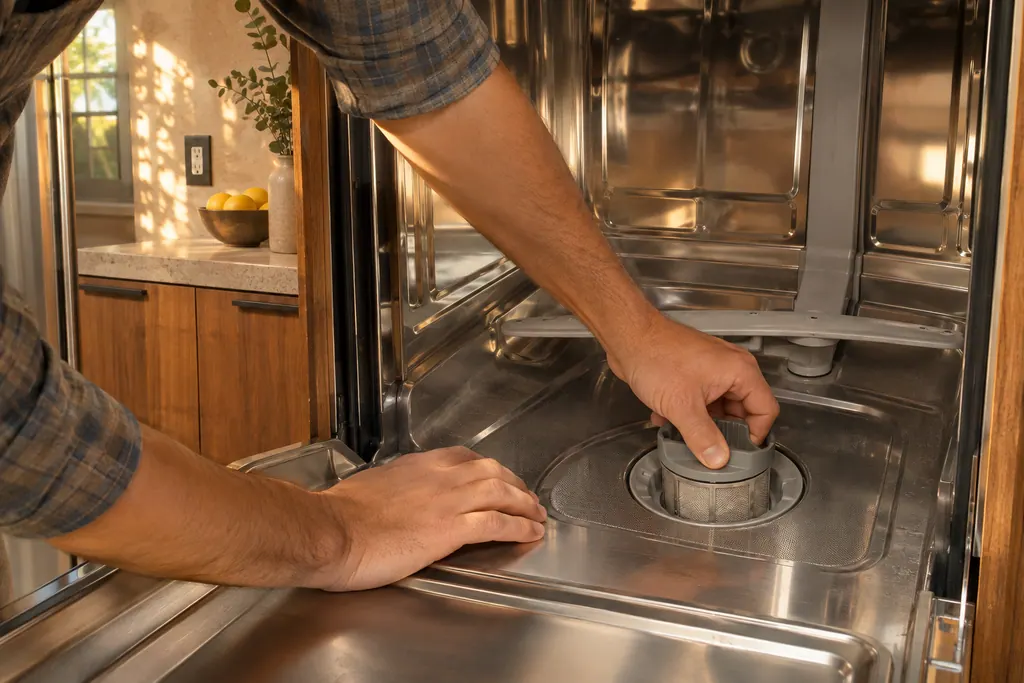
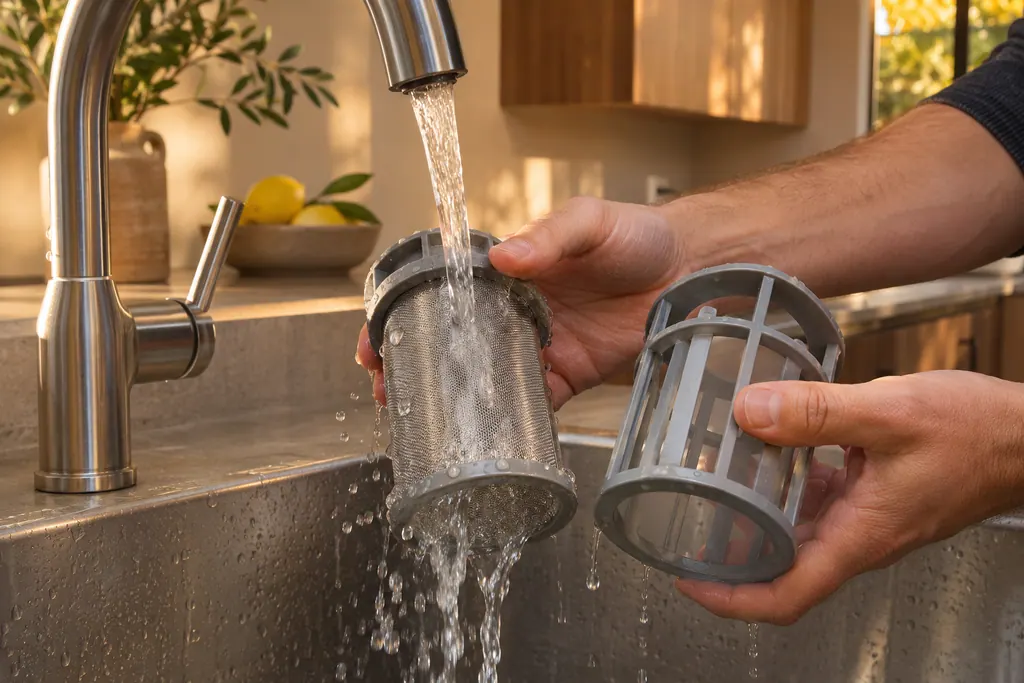
Two cautions come with the filter. Make sure the coarse filter is closed properly, because a loose cover can reduce the filtering performance. 1 And take care when removing the filter, because a hand can be caught between the rotor and the filter. 1
How are the spray nozzles cleaned?#
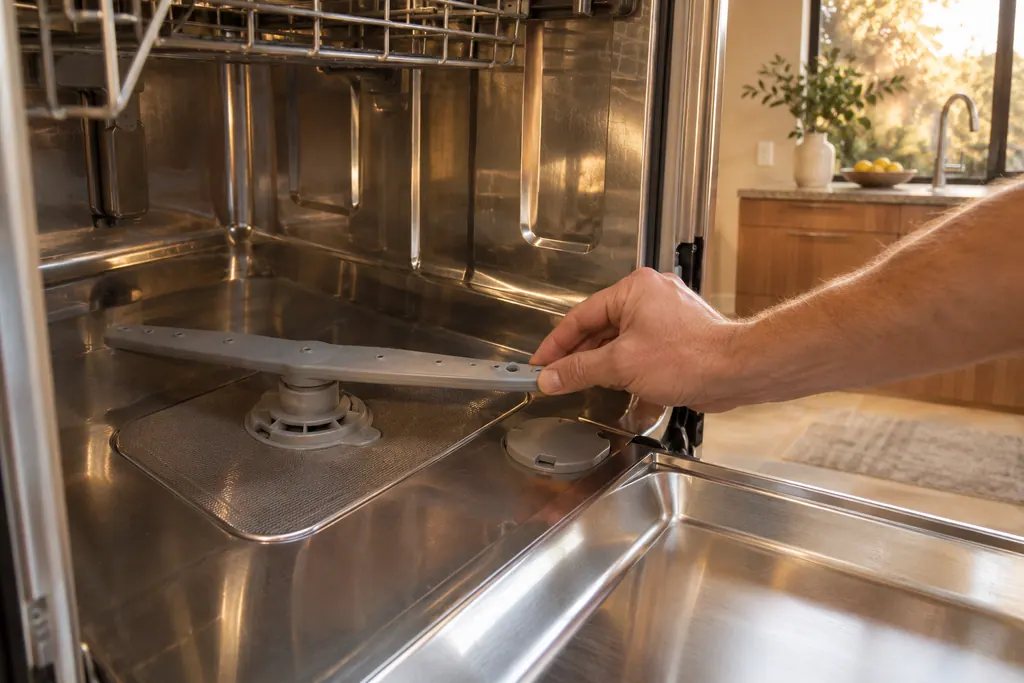
Each nozzle has its own removal steps, and all of them end with the same check: rotate the nozzle by hand to make sure it is engaged correctly. The manual warns to use caution because nozzles may break. 1
- Top nozzle: pull out the upper rack, turn the cap counterclockwise and remove the cap and nozzle, unclog and clean it, reinsert it and tighten the cap clockwise. 1
- Upper nozzle: pull out the upper rack, loosen and remove the nut, remove the nozzle, unclog and clean it, reinsert it and tighten the nut by hand. 1
- Lower nozzle: pull out the lower rack, unclog and clean the nozzle in place, reinsert it and rotate it by hand. 1
What if a nozzle will not turn smoothly?#
The troubleshooting table gives three causes: the nozzle is clogged with food particles, a dish or pot blocks it, or the upper rack is unbalanced. 1 Clean the nozzle, spin it by hand after loading, and level the left and right sides of the upper rack. 1
Food stuck on dishes is a related row. The manual's answers are to select a cycle for the soil level, clean the filters or nozzles, use enough detergent, and check the water pressure (20 to 120 psi) and temperature (120 °F for best performance). 1
When should I open the drain pump cover?#
Only when the dishwasher fails to drain and shows 5C because foreign matter clogs the pump, or when the pump makes an abnormal noise. The cover is not a monthly job. 1
For the steps, remove the lower rack and the micro filter, sponge out moisture, push the cover handle in the direction of the arrow and lift it, check the impeller and clear foreign matter, then press the cover back until it clicks. 1 Our odor and standing water guide has the same steps with pictures.
How do I clean the outside and the control panel?#
Wipe spills off the surface right away, and use a soft damp cloth on the control panel for spills and dust. The manual says not to spray water directly on the dishwasher, because there are electric parts inside. 1
Keep benzene, wax, thinner, chlorine bleach and alcohol away from it. The manual says they may discolor the surface and cause stains. 1 A stainless-steel door panel gets a stainless steel cleaner made for home appliances and a clean, soft cloth. 1 Wipe inside the tub and inside the door with a wet dishcloth on a regular basis to remove dirt and food particles. 1
What if the dishwasher stands unused?#
Drain it first, disconnect the water hose, close the water supply valve along with the circuit breaker. The manual warns that water that stays in the hoses or internal parts can damage the dishwasher. 1
When you start it again, run the internal clean before the first load. A machine that is not used daily is one of the causes of a bad odor in the manual's table. 1
What do 5C and 1C have to do with cleaning?#
Both codes point back to the parts above. For 5C, the drain check, the manual says to close the supply valve and look for a clogged or folded drain hose and a clogged drain hole inside the pump. 1 For 1C, the low-water check, it says to see whether the filter is clogged. 1
Those rows are why this routine matters. See the 5C row and the 1C row in our code library for the full wording.
What should I note before a visit?#
Write down which step you reached, what the filters looked like, whether the nozzles turned freely, plus any code the display showed. Say when you last ran an internal clean and whether the water is hard.
- Did 5C or 1C appear, and when?
- Were the filters clogged with food, or clean?
- Did the lower, upper and top nozzles all spin?
- How hard is the tap water, if you know?
The dishwasher service page explains what a visit covers, the filters entry describes the part, and our page on a dishwasher that is not cleaning covers the case where dishes come out dirty.
Sources#
- User Manual, Built-In Dishwasher DDW24G9000APDacor (Dacor-branded document hosted on image-us.samsung.com) · DD68-00250L-00 (DW8700B), 2024-01-11 · PDF p.64 (Cleaning: Interior), p.65 (Nozzles), p.66-67 (Internal Cleaning, Filter), p.68 (Cleaning the drain pump, Long-term care), p.71 and 73 (Troubleshooting), p.74-75 (Information codes)